

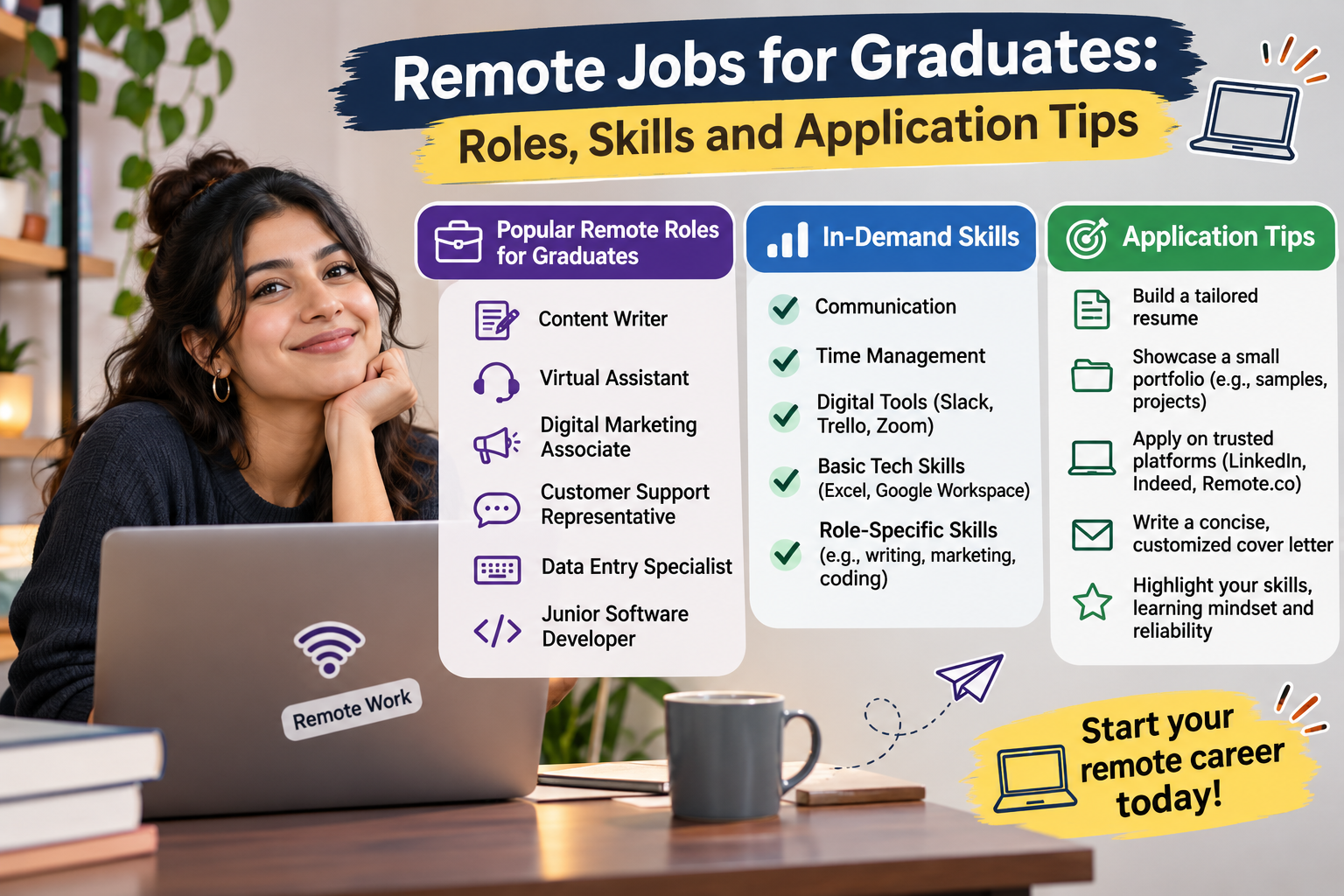
Remote Jobs for Graduates: Roles, Skills and Application Tips
Finishing a degree is an exciting milestone, but finding the right first job can take time. Not every graduate wants to move to another city, travel to an office every day or accept a position that does not match their interests. Remote jobs offer another way to begin a professional career while working from home.
For graduates in India, remote opportunities can be found in areas such as customer support, digital marketing, content writing, administration, software development, data analysis and online sales. Some positions welcome freshers, while others require practical experience, specialised knowledge or a relevant degree.
The challenge is knowing which roles are suitable for your qualifications and how to demonstrate your abilities when you do not have much professional experience. This guide explains the options available, the skills worth developing and how to approach your remote job search more effectively.
What Are Remote Jobs for Graduates?
Remote jobs are positions that allow employees to perform their work outside a traditional office, usually from home. Communication, meetings, project updates and task management take place through digital tools.
Depending on the employer, a remote position may be fully remote, hybrid or location-restricted. Some companies hire employees who live anywhere within India, while others recruit only from particular cities or countries.
Remote employment can be full-time, part-time, contractual or internship-based. Graduates should check the employment arrangement carefully instead of assuming every work-from-home opportunity offers a permanent position.
Best Remote Jobs for Graduates in India
There is no single career path that suits every graduate. Your subject, communication abilities, technical knowledge and interests will influence which opportunities are realistic.
Here are some remote job roles worth exploring.
1. Remote Customer Support Executive
Customer support is one of the career areas graduates can investigate without necessarily having an advanced technical background.
Customer support executives help customers with product questions, account issues, order updates, service requests and complaints. Communication may happen through email, live chat, telephone or video calls.
Typical responsibilities:
- Responding to customer questions through approved communication channels.
- Explaining products, services and company policies.
- Recording complaints and updating customer information.
- Escalating complicated issues to the appropriate department.
- Following up on unresolved customer requests.
Useful skills: Clear written and spoken communication, patience, problem-solving, basic computer knowledge and professional email writing.
Graduates with strong English or regional-language communication skills may also find opportunities in language-specific support teams. Some employers provide product training, although previous customer-facing experience can be an advantage.
2. Digital Marketing Executive
Digital marketing is worth considering if you enjoy online research, communication, creativity and understanding customer behaviour.
Entry-level digital marketing professionals may support SEO campaigns, social media accounts, email marketing, content planning and website updates.
Typical responsibilities:
- Researching keywords and preparing basic SEO reports.
- Scheduling social media posts.
- Assisting with blog content and website updates.
- Monitoring website and campaign performance.
- Researching competitors and audience interests.
Useful skills: SEO fundamentals, content writing, social media management, analytical thinking and familiarity with tools such as Google Analytics and spreadsheet software.
A marketing or business degree can be useful, but employers may also consider graduates from other backgrounds who can demonstrate relevant skills through practical projects.
3. Content Writer or Junior Copywriter
Graduates who enjoy writing may explore content writing and copywriting opportunities. These roles involve creating useful written material for websites, blogs, newsletters, product pages and social media campaigns.
Typical responsibilities:
- Writing and editing website content.
- Preparing articles and informational guides.
- Researching topics before writing.
- Following editorial guidelines and content briefs.
- Updating existing content for accuracy and readability.
Useful skills: Grammar, research, clear writing, editing, basic SEO and the ability to adapt writing styles for different audiences.
A degree in English, journalism or communications may be relevant, but a strong writing portfolio is often more useful than the subject of your degree alone.
4. Virtual Assistant
A virtual assistant provides administrative support to businesses, entrepreneurs or independent professionals from a remote location.
This can be a practical starting point for graduates who are organised and comfortable handling routine office tasks.
Typical responsibilities:
- Managing emails and calendars.
- Organising online meetings.
- Preparing documents and spreadsheets.
- Conducting basic online research.
- Maintaining records and tracking deadlines.
Useful skills: Time management, attention to detail, professional communication, Microsoft Office or Google Workspace and basic project coordination.
Some virtual assistant positions require experience with specific tools or industries, so read the job description before applying.
5. Junior Data Analyst
Graduates who enjoy working with numbers and information can consider entry-level data analyst positions.
Junior analysts help organisations organise datasets, prepare reports, identify patterns and present findings that support business decisions.
Typical responsibilities:
- Cleaning and organising data.
- Preparing spreadsheets and basic reports.
- Using formulas and pivot tables in Excel.
- Creating charts and simple dashboards.
- Checking information for inconsistencies.
Useful skills: Excel, logical reasoning, basic statistics, data visualisation and, depending on the position, SQL or Power BI.
Graduates in mathematics, statistics, computer science, economics and business-related subjects may find their academic background relevant. However, practical data projects are valuable for candidates from other disciplines too.
6. Junior Software Developer or Web Developer
Technology graduates and candidates with demonstrable programming skills can explore junior development opportunities.
Depending on the organisation, entry-level developers may work on website features, application maintenance, bug fixes, testing and documentation.
Typical responsibilities:
- Writing and reviewing basic code.
- Fixing bugs under senior developer guidance.
- Testing website or application functionality.
- Working with version control systems.
- Documenting development work.
Useful skills: HTML, CSS, JavaScript, Python, Java or another relevant programming language, problem-solving and familiarity with Git.
A degree in computer science or information technology can help, but employers generally assess the technologies required for the particular position.
7. Online Sales and Business Development Executive
Remote sales roles involve contacting potential customers, explaining products and services, following up on enquiries and supporting the sales process.
Typical responsibilities:
- Identifying potential customers.
- Responding to sales enquiries.
- Conducting online product demonstrations.
- Updating customer information in CRM software.
- Following up with prospective clients.
Useful skills: Communication, persuasion, active listening, negotiation and basic CRM knowledge.
Before accepting a sales position, check whether compensation is fixed, commission-based or a combination of both. Understand the targets and payment conditions clearly.
8. Online Research Assistant
Research assistant positions can suit graduates who are comfortable finding, checking and organising information.
Depending on the employer, the work may involve market research, competitor analysis, survey information, academic support or business reporting.
Typical responsibilities:
- Collecting information from reliable sources.
- Checking facts and organising research notes.
- Preparing summaries and spreadsheets.
- Comparing products, services or market trends.
- Supporting reports and presentations.
Useful skills: Research, critical thinking, attention to detail, spreadsheet knowledge and professional writing.
9. Remote HR or Recruitment Assistant
Graduates interested in human resources can look for junior recruitment and HR support positions.
These roles may involve coordinating interviews, updating applicant records, communicating with candidates and helping recruitment teams manage their schedules.
Useful skills: Organisation, communication, confidentiality, spreadsheet knowledge and familiarity with applicant tracking systems.
A degree in human resources, business administration or psychology may be useful, depending on the employer’s requirements.
Which Remote Jobs Are Suitable for Fresh Graduates?
Not all remote positions require previous full-time employment. Some employers consider academic projects, internships, freelance work and practical demonstrations when assessing entry-level applicants.
The following comparison can help you narrow down your options.
| Job Role | Useful Background | Experience Consideration |
|---|---|---|
| Customer Support Executive | Any relevant graduate background | Some employers consider freshers |
| Digital Marketing Executive | Marketing, business, communications | Portfolio or practical projects help |
| Content Writer | English, journalism, humanities or other fields | Writing samples are valuable |
| Virtual Assistant | Any organised, task-oriented background | Practical administrative skills matter |
| Junior Data Analyst | Mathematics, statistics, IT, business | Demonstrable data skills are important |
| Junior Developer | Computer science, IT or programming knowledge | Projects and coding ability matter |
| Online Sales Executive | Business, marketing or communication | Some entry-level positions are available |
| Research Assistant | Research-oriented academic background | Research samples can strengthen applications |
| Recruitment Assistant | HR, psychology, business administration | Some junior roles accept freshers |
These are general career pathways, not confirmed current vacancies. Actual eligibility depends on the employer, job responsibilities and location.
Skills Required for Remote Jobs After Graduation
Having a degree is a starting point, but working remotely also requires the ability to manage tasks, communicate clearly and deliver work without constant supervision.
Some skills are relevant across almost every remote profession.
1. Communication Skills
Remote employees cannot always walk over to a colleague’s desk to clarify something. They need to explain problems, ask questions and share updates through email, chat and online meetings.
Practise writing clear professional emails, summarising completed work and communicating delays before they become bigger problems.
2. Digital and Computer Skills
Basic digital knowledge is essential. You should be comfortable using email, web browsers, video conferencing applications, document editors and spreadsheets.
Depending on your career direction, you may also need specialised software. Microsoft Learn provides training resources covering Excel, Microsoft 365, Teams and other workplace tools.
3. Time Management
Remote work often involves deadlines and independent task management. Employers want people who can organise their workload and complete assignments without repeated reminders.
Use a calendar or task manager to plan your day. Break larger assignments into smaller tasks and keep track of pending work.
4. Problem-Solving Ability
Unexpected problems are part of every job. A remote employee should be able to investigate an issue, identify possible solutions and explain when additional assistance is needed.
5. Adaptability and Willingness to Learn
Workplace tools and processes change. Graduates who are willing to learn new software, follow feedback and improve their working methods can adjust more easily to different remote environments.
6. Basic Cybersecurity Awareness
Remote employees may access company documents, customer records and internal communication systems from home. Understanding password security, phishing messages, safe file sharing and multi-factor authentication is important.
How to Find Remote Jobs for Graduates in India
Searching for remote jobs requires more than typing work from home into a search engine. A better approach is to identify suitable job titles, use reliable platforms and check each employer before applying.
1. Register on the National Career Service Portal
The National Career Service (NCS) is a Government of India employment platform that provides job search, job matching, career guidance and related employment services.
Graduates can create a jobseeker profile and explore relevant opportunities. The portal also provides information about career centres, job fairs and skill development resources.
NCS states that its services are free at every stage of registration, job application and interview processing. It also warns users about fraudulent websites and individuals falsely claiming an association with the service.
2. Use LinkedIn Job Search
LinkedIn Jobs allows job seekers to search by designation, location and workplace type.
To find relevant opportunities:
- Complete your LinkedIn profile with your education, skills and projects.
- Open the Jobs section.
- Search for a suitable job title, such as Junior Content Writer or Customer Support Executive.
- Select the Remote workplace filter where available.
- Refine results using experience level and employment type.
- Review the employer and application instructions.
- Save relevant searches and enable job alerts.
LinkedIn’s official help documentation explains how to search for remote opportunities and refine job results using available filters.
3. Explore Reputable Job Portals
You can also explore established employment platforms to discover remote and entry-level positions. Examples include:
- LinkedIn Jobs – Professional networking and job discovery.
- National Career Service – Government-supported employment services in India.
- Indeed – Job search across different industries and locations.
- Foundit India – Employment opportunities across professional categories.
Use these platforms as discovery tools rather than treating every listing as verified. Whenever possible, confirm the vacancy on the employer’s official careers website.
4. Visit Company Career Pages
Another useful approach is to identify companies operating in your preferred industry and check their careers sections regularly.
Search for positions using terms such as:
- Graduate trainee remote
- Junior executive remote
- Entry-level work from home
- Remote customer support fresher
- Junior marketing associate
- Remote internship
Read the location and eligibility requirements carefully. A position described as remote may still be limited to applicants living in a particular country or region.
How to Apply for Remote Jobs as a Graduate
A focused application process is generally more useful than sending the same CV to dozens of unrelated employers.
Step 1: Choose Two or Three Suitable Job Roles
Start with your qualifications and existing abilities. For example, a commerce graduate who enjoys working with numbers might explore junior accounting support, data entry or reporting roles.
A graduate with strong writing skills may be better suited to content writing, communications or digital marketing.
Choosing a small number of related roles makes it easier to prepare relevant applications.
Step 2: Prepare a Professional CV
Your CV should make it easy for a recruiter to understand your education, skills and suitability for the position.
If you have no full-time experience, include:
- Your degree, institution and graduation year.
- Relevant academic projects.
- Internships and volunteer experience.
- Technical and communication skills.
- Relevant online courses or certifications.
- Portfolio or project links, where applicable.
Avoid adding skills you cannot demonstrate. For more guidance, explore CareerMala’s resume writing resources.
Step 3: Build a Small Portfolio
A portfolio can help fresh graduates demonstrate their abilities without depending entirely on previous employment.
Examples include:
- Content writing: Three or four original articles on different topics.
- Digital marketing: A sample SEO audit or social media content plan.
- Data analysis: A spreadsheet project with charts and a short explanation of the findings.
- Web development: A personal website or small application.
- Graphic design: A collection of original design samples.
- Virtual assistance: A sample calendar, organised spreadsheet or administrative workflow.
Use fictional or publicly available sample data where appropriate. Do not include confidential information from previous employers or clients.
Step 4: Write a Relevant Cover Letter
A short cover letter should explain why you are interested in the role and what you can contribute.
For example, a graduate applying for a junior marketing position could mention a completed SEO project, familiarity with keyword research and an interest in learning campaign management.
Keep the message specific to the employer rather than sending the same generic introduction to every company.
Step 5: Prepare for Online Interviews
Remote interviews may take place through video conferencing, telephone calls or online assessments.
Prepare by:
- Testing your internet connection, camera and microphone.
- Choosing a quiet place for the interview.
- Researching the employer and the advertised role.
- Preparing examples of your academic projects or practical work.
- Practising clear answers to common interview questions.
You should also be ready to explain how you organise tasks, handle deadlines and communicate when working independently.
Can Graduates Get International Remote Jobs from India?
Yes, Indian graduates can apply for some international remote positions, but working remotely does not automatically mean a company can employ someone from any country.
International employers may have restrictions relating to residence, payroll, taxation, employment law, data security and working hours.
For example, a remote vacancy advertised by a US company may be open only to candidates legally authorised to work in the United States. Another company may accept applicants living in India through an international employment arrangement or independent contractor agreement.
Before applying, check:
- Whether applicants based in India are eligible.
- Whether the position is employment or independent contracting.
- Which country’s employment rules apply.
- Whether the employer supports international payments.
- Whether working hours overlap with the company’s time zone.
- How taxes, benefits and contractual obligations are handled.
International job listings should be assessed individually. Never assume that a job advertised as worldwide is automatically available to every applicant.
Common Mistakes Graduates Should Avoid
Many graduates spend considerable time searching for remote jobs but struggle to receive interview invitations. Sometimes the problem is not a lack of qualifications but the way they approach applications.
- Applying without reading the requirements: Check whether your education, skills and location match the vacancy.
- Using one CV for every job: Adjust your skills and project descriptions to match the position.
- Ignoring practical experience: Academic projects and internships can demonstrate your abilities.
- Applying only through social media: Verify opportunities through official company channels.
- Expecting immediate results: Finding a suitable position can take time, particularly without professional experience.
- Overlooking employment terms: Understand salary structure, working hours, contract conditions and responsibilities before accepting an offer.
- Claiming skills you do not have: Be honest about your knowledge and willingness to learn.
How to Recognise Fake Remote Job Offers
Remote job seekers, especially fresh graduates, can be targeted by fraudulent recruitment offers. Scammers may advertise easy work, unusually high payments or guaranteed income to attract applicants.
India’s National Cyber Crime Threat Analytics Unit has specifically warned about fake CAPTCHA-filling job scams. These offers may promise high earnings for simple work and later demand registration, training or withdrawal fees.
Watch out for these warning signs:
- Requests for registration, security or placement fees.
- Promises of unusually high income for very little work.
- Recruiters communicating only through unverified WhatsApp or Telegram accounts.
- Requests for OTPs, banking passwords or unnecessary financial information.
- Job offers without a proper interview or clear job description.
- Pressure to deposit money to unlock tasks or withdraw earnings.
- Fake company email addresses and websites impersonating genuine employers.
Never pay someone to secure a job. Verify the company through its official website and contact details before sharing sensitive documents.
If you encounter suspected online financial fraud in India, report it through the National Cyber Crime Reporting Portal or call 1930 for the financial cyber fraud helpline.
A Practical 30-Day Plan to Start Applying
Graduates who are unsure where to begin can use this simple four-week plan to organise their preparation.
| Period | What to Do |
|---|---|
| Week 1 | Choose suitable job roles, review job descriptions and identify missing skills. |
| Week 2 | Improve relevant skills and practise using the tools required for your chosen roles. |
| Week 3 | Prepare your CV, LinkedIn profile and two or three practical portfolio projects. |
| Week 4 | Apply to relevant vacancies, practise interviews and follow up professionally. |
This is a preparation schedule, not a guarantee of employment. Continue improving your skills and adjusting your applications based on the responses you receive.
Final Thoughts
Remote jobs can give graduates an opportunity to begin their careers without being restricted to traditional office-based employment. However, finding the right position requires preparation, patience and a clear understanding of what employers expect.
Start by choosing a role that matches your education and interests. Develop the necessary skills, prepare a professional CV and create a few practical projects that demonstrate what you can do.
Most importantly, focus on genuine opportunities rather than promises of quick income. A suitable entry-level remote position can become a valuable starting point for building experience, improving professional skills and developing a long-term career.